


Shop Stats: The Next 5 Years and the Biggest Challenges Ahead
July 02, 2026
Industry Trends & Insights
Shop Tips & Best Practices
5 min read
The shops that come out ahead in the next five years won’t be the ones that avoided the industry’s challenges – they’ll be the ones that saw them coming and planned for them. Rising costs, evolving technology, and the labor shortage puts a strain on shops of all sizes, but that pressure also provides insights into where a shop should focus and which path forward is the most effective.
Challenges and Opportunities Ahead
In a recent OEC survey of ~700 shops, economic uncertainty topped the list of concerns for shop owners in the next five years, and it’s easy to see why. Rising costs touched every part of the business, from parts pricing to staffing to day-to-day overhead. It’s clear that shops simply do not have the ability to absorb cost increases without passing them along or cutting into their margins.
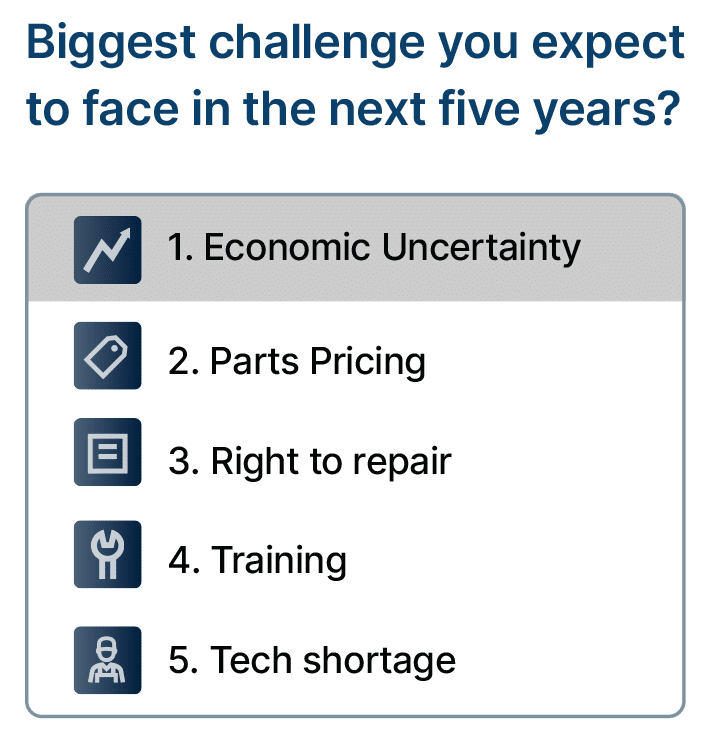
While economic uncertainty is the top concern for repair shops, parts pricing, Right to Repair, the training demands of increasingly complex vehicles, and the technician shortage round out the list of the biggest challenges shops expect to face in the future. While each of these pressures has a different root cause, they all point to the same solutions: shops need to run tighter, train smarter, and plan further ahead than in years past.
This does not mean shops have limited options. In fact, shops that get ahead of these pressures, whether it’s through stronger training, tighter processes, or smarter parts sourcing, put themselves in a stronger position than those that wait for the pressure to ease on its own. The key, then, is taking a proactive approach to addressing these challenges.
Where to Focus Improvement Efforts
When we asked shops where they wanted to improve their operations, most reported to five common areas: benefits and work-life balance, shop growth, profit, technology, and workflow or process improvements.

Workflow improvements stood out as the most common response when shops identified areas they wanted to improve. Fortunately, workflow and process enhancements also offer more immediate payoffs for shops. These types of improvements consist of:
- Stronger communication. Tightening internal and external communication reduces friction and cuts down on costly mistakes.
- Shop organization and cleanliness. Improve efficiency and make a stronger first impression on customers, while providing a better environment for employees.
- Scheduling management. Maximize technician time and avoid coordination bottlenecks.
- Parts sourcing and availability. A strong sourcing strategy means faster turnaround times and fewer stalled repairs.
- Training opportunities. Close employee skill gaps and keep pace with increasingly complex vehicles.
- Customer engagement. Build trust and loyalty to keep customers coming back in a competitive market.
The other themes surveyed shops identified as areas of improvement include better benefits and work-life balance for employees, shop growth, profitability, and technology adoption. Employees increasingly weigh flexibility and quality of life alongside pay, making benefits a growing factor in both hiring and retention. Growth and profitability remain closely linked, as shops look for ways to expand their customer base while protecting their margins. Technology, meanwhile, continues to reshape how shops diagnose, repair, and manage vehicles; staying current is increasingly tied to staying competitive. All of these areas, while distinct, point to the same underlying goal: building a shop that can adapt and grow sustainably over time.
Shop Takeaway
Moving forward, the challenges ahead are real, but so are the opportunities to build a more resilient shop. Shops don’t need to tackle every pressure point at once. Picking one or two of these areas – whether that means tighter scheduling, investments in training, or leveraging an optimized parts sourcing strategy – and focusing on them consistently can make a sustainable difference.
Start with workflow, training, and parts:
- Workflow is one of the biggest levers to pull. Communication, scheduling, and shop organization are the most common areas shops seek to improve, and they’re often easier to fix and produce near-term results.
- Training pays off twice. Closing skill gaps helps shops keep pace with increasingly complex vehicles while also addressing the technician shortage from the inside.
- A parts sourcing strategy is a must. A stronger sourcing strategy directly reduces stalled repairs and improves turnaround times.
The shops pulling ahead are treating resilience as an ongoing practice, not a one-time fix. They revisit their workflow, training, and sourcing decisions regularly instead of setting them once and moving on. To get started, pick one or two areas and work at them consistently, and your shop will be in a far stronger position to handle whatever the next five years bring. Resilience isn’t built overnight, but shops that start now will likely be the ones standing strong in the future.
Make sourcing parts the easy part of your day & save 15 minutes per RO with PartsTech! To learn more, connect with a PartsTech pro. Complete the form below and we will be in touch.

You may also like
Shop Stats: Insights into Parts Ordering & How to Improve the Process
A shop’s parts ordering process rarely gets the spotlight, but it quietly shapes almost everything else that happens on the floor. A tight, well-run process keeps technicians …
Find Out More

The Looming Succession Crisis & What Smart Shops Are Doing About It
OEC’s U.S. General Auto Repair Shop Survey Report, drawn from nearly 700 shops surveyed in September 2025, puts hard numbers behind what many owners already sense on …
Find Out More

Shop Stats: The Tech Behind Top Shops
Below is an excerpt from the OEC U.S. General Auto Repair Shop Survey Report. Inherited from PartsTech, and in the spirit of the annual State of General …
Find Out More